
Tokenized Deposits vs Stablecoins: The Bank’s Dilemma
19 January 2026Introduction
Money is becoming programmable, real time, and increasingly detached from traditional banking infrastructure. As digital assets move from experimentation to production, banks are being forced to confront a fundamental question about their future role in the financial system: should the next generation of digital money be built on tokenized bank deposits, or on stablecoins? This is no longer an abstract innovation debate – it goes to the core of how money is issued, controlled, and trusted.
What began as a fringe discussion in crypto-native communities has evolved into a strategic and regulatory priority for banks, payment providers, and policymakers. Both tokenized deposits and stablecoins promise faster settlement, 24/7 availability, and programmable payments. Both are already operating in live environments. And both challenge long-standing assumptions about the structure of monetary systems. The choice between them carries far-reaching implications for balance sheets, payment economics, and systemic stability.
Pressure Is Coming From All Sides

Banks face mounting pressure from multiple directions at once. Customers and corporates increasingly expect instant, cross-border payments that operate continuously. Fintechs and crypto-native firms are building dollar-denominated payment rails outside the traditional banking system. Regulators and central banks, meanwhile, are pushing for innovation while insisting on financial stability and consumer protection. These forces leave banks with limited room to delay strategic decisions.
In response, two distinct models of digital money have gained momentum. Tokenized deposits are issued by regulated banks and backed one-to-one by on-balance-sheet deposits. Stablecoins are typically issued by non-bank entities and backed by reserves held outside the traditional deposit framework. For banks, this is not simply a technology choice – it is a decision about relevance, control, and trust in a changing payments landscape.
Fintechs which are building alternative real-time payment rails
These firms are rebuilding the plumbing of global money movement without using blockchains or stablecoins. Instead, they operate fully within the fiat system, holding regulated licenses, partnering with banks, and connecting directly into domestic real-time payment networks. Their core value proposition is to replace or bypass the slow, opaque, and expensive correspondent banking model by offering instant or near-instant settlement, API-based access, and transparent pricing.
Rather than acting as simple payment processors, these companies function as network orchestrators: they maintain local clearing connections, banking relationships, and regulatory coverage across dozens or hundreds of countries. This allows them to route payments intelligently across local rails, achieving speed and cost efficiency that traditional SWIFT-based transfers struggle to match.
While they do not issue money themselves, they increasingly control the customer interface, the routing logic, and the liquidity layer – areas that historically belonged to banks.

CROSS-BORDER B2B RAILS
Wise
Wise is best known for retail transfers, but its infrastructure is increasingly B2B. It operates a global network of local bank accounts that lets users send money domestically in one country and pay out domestically in another—avoiding SWIFT entirely. This “local-to-local” model dramatically reduces fees and settlement times.
Core value:
- Real exchange rates
- Near-instant settlement in many corridors
- Transparent fees
- Multi-currency wallets
Strategically, Wise shows how far you can go just by rearchitecting fiat flows without touching crypto.
Airwallex
Instead of using correspondent banks for everything, Airwallex maintains local clearing access and liquidity pools. This lets them move money faster and cheaper than traditional bank wires.
Nium
Nium is an infrastructure provider powering payments for other fintechs, platforms, and marketplaces. It focuses on: mass payouts, card issuing, embedded wallets, global disbursements. Nium’s edge is its regulatory footprint and direct access to domestic payment rails. That allows platforms to embed financial services without becoming banks themselves.
Strategically, this turns payments into a modular service rather than a banking relationship.
Thunes
Thunes specializes in high-friction corridors: Africa, Southeast Asia, Latin America. It connects mobile wallets, banks, and cash-out points into a single network. This is especially important for: remittances, gig economy payouts, NGO disbursements, cross-border e-commerce.
Thunes replaces chains of correspondent banks with direct local endpoints.
Paysend
Paysend focuses on making international money transfers instant, simple, and card-to-card, bypassing traditional banking rails where possible.
Their core idea: move money the way the internet moves data – fast, borderless, and user-friendly.
Their key value:
- Card-to-card rails – direct transfers to Visa/Mastercard cards in 170+ countries
- Fixed, transparent pricing – no FX opacity, no hidden fees
- Consumer-grade UX on top of fintech infra – simplicity as a product feature
- Speed over banking complexity – real-time or near-instant settlement
Paysend is vertically integrated: it owns the user experience, the transfer logic, and much of the distribution.
Currencycloud (Visa) – FX + cross-border APIs
Currencycloud provides programmable access to: FX, virtual accounts, international payouts, treasury services. It’s a classic example of banking-as-a-service for cross-border money. Visa’s acquisition highlights how strategically important this layer has become.
Instant domestic rails (examples). These are not fintechs – they are national or regional infrastructures that reset customer expectations.
| Rail | Country/Region | What changed |
| RTP | US | 24/7 instant settlement |
| FedNow | US | Public-sector instant rail |
| PIX | Brazil | Real-time, QR-based, ubiquitous |
| UPI | India | Mobile-first, free, universal |
| Faster Payments | UK | Near-instant domestic |
| SEPA Instant | EU | Cross-border euro instant |
At a national level, they enhance financial inclusion, reduce reliance on foreign networks, and strengthen monetary sovereignty. For banks, they are not optional upgrades – they are the new minimum standard.
Crypto-native & stablecoin-based payment rails (non-bank issued)
These are building dollar-denominated rails outside the traditional banking system, often running 24/7 on public blockchains.
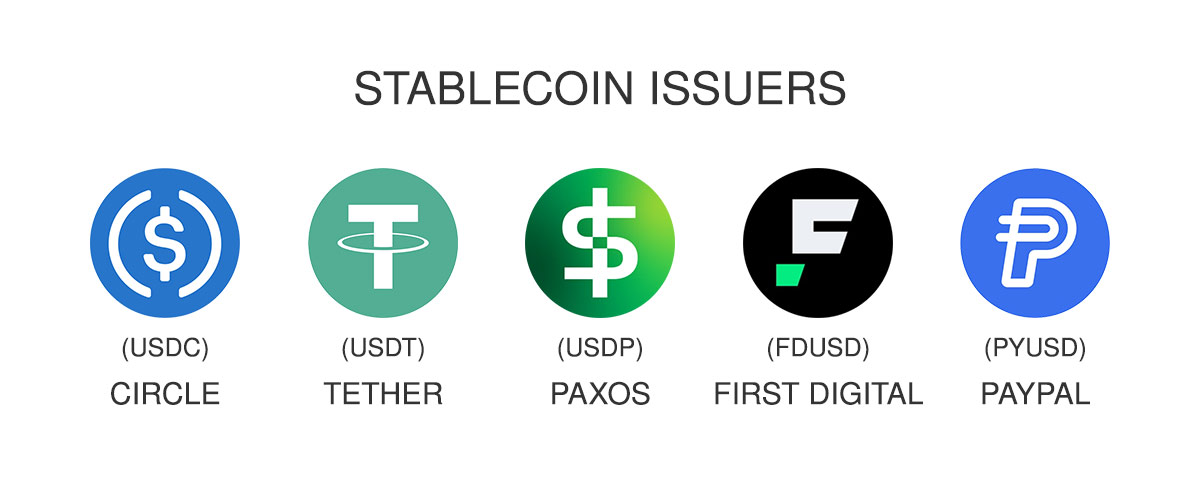
CRYPTO-NATIVE PAYMENT RAILS
These use stablecoins as settlement assets:
- Stripe Crypto Payouts – USDC payouts on Solana, Ethereum
- Bridge (Stripe-owned) – Stablecoin orchestration for fintechs
- BVNK – Stablecoin-based B2B payments and treasury
- Fireblocks – Infrastructure for stablecoin-based settlement
- Circle Payments Network (CPN) – Cross-border stablecoin settlement
- RippleNet / XRP Ledger – On-chain settlement network
- Stellar – Used for USDC remittances and NGO disbursements
- Tron – Dominant USDT rail in emerging markets
Tokenized Deposits: Modernizing Bank Money

Tokenized deposits represent a bank-led effort to bring traditional deposit money into modern, ledger-based infrastructure. In this model, a conventional bank deposit is represented as a digital token while remaining fully within the regulated banking system. Deposits stay on balance sheet, and existing safeguards – such as deposit insurance and prudential oversight – remain intact.
The appeal for banks is straightforward:
- Settlement can occur in near real time
- Payments become programmable and automatable
- Corporate treasury and liquidity management improve
- Bank-issued money remains central to payment flows
Tokenized deposits aim to deliver innovation without disintermediation, allowing banks to evolve without surrendering their core role.
Stablecoins: A Parallel Payments Ecosystem
Stablecoins have taken a different path, growing rapidly outside the banking perimeter. Typically pegged to fiat currencies, they move natively on public blockchains, enabling instant, borderless, and continuous transfers. Their design prioritizes accessibility, interoperability, and developer adoption rather than integration with existing banking infrastructure.
Their growth has been driven by:
- Frictionless cross-border settlement
- Deep integration with digital asset markets
- Strong platform and developer ecosystems
- Rapid adoption by fintechs and global platforms
For many users, stablecoins already function like digital cash. This reality raises uncomfortable questions for banks about whether future payment flows will continue to pass through traditional deposit systems.
The Strategic Dilemma for Banks

At first glance, the debate between tokenized deposits and stablecoins appears technical. In reality, it is deeply strategic. If stablecoins become the dominant settlement instrument, banks risk losing deposits, visibility into money flows, and control over payment economics. If tokenized deposits fail to scale, innovation may accelerate outside the regulated system, pushing banks further from emerging digital ecosystems.
Banks are navigating a narrow path between urgency and responsibility. They must move quickly enough to remain relevant in an evolving payments landscape, while exercising the discipline required to safeguard trust, stability, and regulatory confidence. The challenge is not choosing between innovation and safety, but embedding both into the same operating model.
Why This Decision Matters Now
Until recently, banks could afford to observe. That window is closing. Large-scale pilots are moving into production, regulatory frameworks are taking shape, and major institutions are investing heavily in tokenization platforms. At the same time, stablecoin usage continues to grow, particularly in cross-border payments and digital commerce.
The question is no longer whether digital money will reshape banking. It is who will issue it, who will control it, and who will capture its value. The decisions banks make now will define their role in the financial system for years to come.